Sunday, May 6, 2018

Reducing Tax Burden on Enterprises Has Given Obvious Boost to Economy

The value added tax for manufacturing was lowered from 17 to 16 percent on Tuesday, while the rate for transportation, construction, basic telecommunication services and farm produce was reduced from 11 to 10 percent. The government also unified the standard for small-scale taxpayers and returned the withholdings of value added tax of some industries. Beijing News commented on Wednesday:
The tax cuts have generated immediate effects. The price of gasoline and diesel dropped by 75 yuan ($12) per ton and 65 yuan per ton respectively, and the prices of some automobiles dropped by tens of thousands of yuan.
The tax cuts will amount to 400 billion yuan ($64 billion) this year. This will not only directly benefit enterprises, it will also have a chain reaction that will boost consumption growth.
Reducing the tax burden on enterprises is an important goal of the government this year, as it targets a crucial problem hindering the development of enterprises.
It should be regarded as part of the supply-side structural reform to boost production and drive up consumption's share in the economy.
Supply-side structural reforms have harvested obvious effects. Data from the National Bureau of Statistics show that the total retail sales of consumer goods hit 36.6 trillion yuan last year, up 10.2 percent from 2016. This is the 14th year that it has grown at a double-digit speed.
Consumption plays a fundamental role in driving economic growth. The robust growth of consumption will promote the restructuring of the national economy, and boost the development of the service sectors. Echemi Promotion

Chemical price increase letter keeps coming

    Zhanxin

    At the United States Coatings Show for the first time in a brilliant debut of Zhanxin due to various reasons announced from May 1, Europe, the Middle East and Africa, all amino resin prices rise; the same time, powder coating resin products arrival prices. The price of indoor products/outdoor products/super weather-resistant products was increased by RMB 400/t. The price of ADDITOL products remained unchanged. Weekly Price on Echemi.com

    Gongga Snow

    Under the heavy pressure of the downstream application market, and domestic and provincial environmental supervision, the Sichuan Gongga Snow New Material Co., Ltd. recently issued a notice to raise the price of the Gonggaxue series of products. From May 1, the price of the "Gong Gong Xue" calcium carbonate series will be raised. The price of coarse products was raised by RMB 20/ton for 400 mesh, and RMB 30/ton for fine products.

    Clariant

    Clariant, a leading global manufacturer of specialty chemicals, recently announced that it will implement global price increases for most of its pigments and dyes, which will be 5% to 20%, due to sustained price increases of major raw materials, and in 2018 Effective on May 1 or according to the terms of the contract.

    The continuous rise in raw material prices will also drive price fluctuations in the downstream chemical market.

Chinese Acetone Market Fluctuated Up in Apr 2018

In April 2018, the Chinese acetone market fluctuated up. The overall trading was modest. Up to April 30, 2018, reference negotiation prices for acetone in Jiangsu and Zhejiang were around RMB 5,650/mt, up RMB 525/mt or 10.24% month on month. The average price was RMB 5,510/mt, increasing RMB 240/mt or 4.55% month on month. Echemi Mall

In H1 April, propylene prices moved up. Few acetone producers raised prices. Chinese acetone producers increased prices by RMB 300/mt. Holders in the Chinese market were unwilling to sell goods at low prices. Mainstream prices inched up. In H2 April, the Chinese acetone market prices became stable. Phenolic ketone units at Sinopec Beijing Yanshan Company were shut and the phenol unit at Formosa Industries (Ningbo) continue to be shut. The phenolic ketone unit at Lihuayi was shut for 3 days. The supply in the Chinese market declined. The inventory at ports was less than 20kt. Producers were bullish about the market while the demand was tepid. The overall trading was weak. 

Saturday, April 28, 2018

Chinese Isopropanol Market Moved Up This Week

Isopropanol Market Price
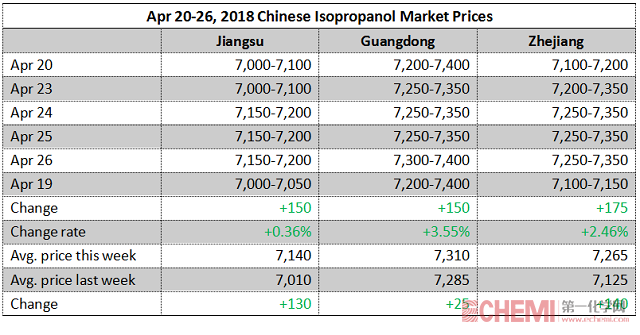
The Chinese isopropanol market fluctuated up this week. Up to April 26, 2018, the closing prices for isopropanol in Jiangsu were in the range of RMB 7,150-7,200/mt, up RMB 150/mt or 2.13% week on week. The supply was tight and isopropanol producers held firm offers. Some traders were reluctant to sell goods at low prices. Moreover, acetone prices moved up, which supported the isopropanol market. Market prices continued moving up, and the mainstream negotiation prices followed the uptrend. The downstream demand remained flat.  chemical solvents

Chinese Titanium Dioxide Market Moved Marginally This Week

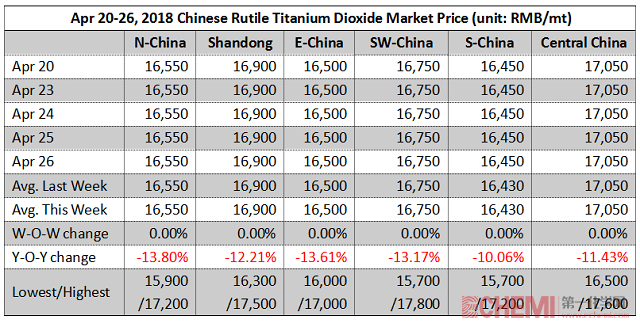
The Chinese rutile titanium dioxide market remained largely stable. Up to april 26, 2018, mainstream negotiation prices for rutile titanium dioxide were in the range of RMB 15,700-18,000/mt. The average price was RMB 16,700/mt, unchanged from last week. Producers’ offers were stable and the overall operating rate was largely stable.  List of titanium dioxide
rutile titanium dioxide
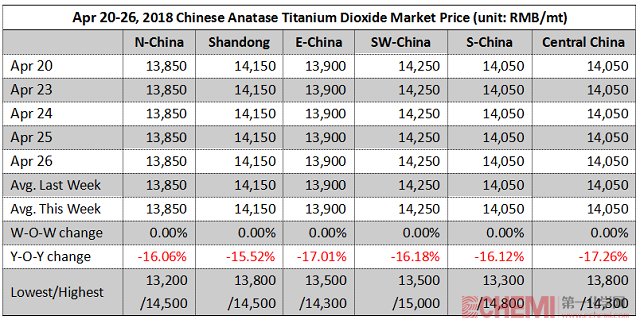
The Chinese anatase titanium dioxide market remained stable this week. Up to April 26, 2018, mainstream negotiation prices for anatase titanium dioxide were in the range of RMB 13,200-14,800/mt. The average price was RMB 14,042/mt. The operating rate was stable. The overall trading was cautious.    
anatase titanium dioxide
Forecast:
The supply and demand in the Chinese rutile titanium dioxide market will be stable. Raw materials prices will move weakly and the downstream demand for titanium dioxide will be flat. It is predicted that the Chinese titanium dioxide market will continue to move marginally. 

Chinese Cyclohexanone Market Saw Thin Tradings This Week

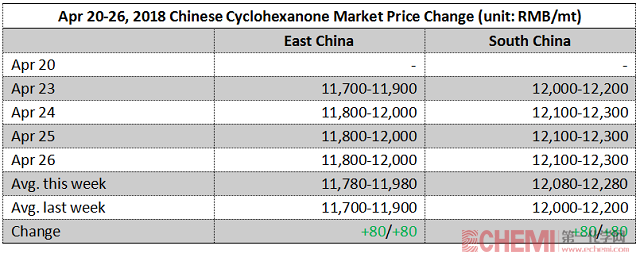
Market Review: The Chinese cyclohexanone market moved firmly this week. Benzene prices moved marginally at lows, and the support to cyclohexanone producers was weak. Some units were shut and the inventory was consumed to a low level. Producers’ sentiments were fairish. Traders operated flexibly. Up to April 26, 2018, prices for cyclohexanone in Shandong were in the range of RMB 11,500-11,700/mt, up RMB 80/mt. Prices for cyclohexanone in East China were in the range of RMB 11,800-12,000/mt, up RMB 80/mt.
cyclohexanone price
Forecast: The benzene market will continue to move marginally in the short term. The support to the cyxlohexanone market is not ample. Producers will hold firm offers in the short term. However, the downstream demand will continue to be weak, especially in the chemical fiber market. It is predicted that the cyclohexanone market will continue to move weakly in the short term. 
List of cyclohexanone: https://www.echemi.com/searchGoods/pid_Seven3075-cyclohexanone.html

Tuesday, April 17, 2018

New Fluorescent Dyes Could Advance Biological Imaging

With a new technique to craft a spectrum of glowing dyes, chemists are no longer chasing rainbows. Pigment Suppliers

Swapping out specific chemical building blocks in fluorescent molecules called rhodamines can generate nearly any color scientists desire—ROYGBIV and beyond, researchers report September 4, 2017 in the journal Nature Methods.

The work offers scientists a way to adjust the properties of existing dyes deliberately, making them bolder, brighter, and more cell-permeable too. Such an expanded palette of dyes could help researchers better illuminate the inner workings of cells, says study leader Luke Lavis, a group leader at the Howard Hughes Medical Institute's Janelia Research Campus in Ashburn, Virginia. His team lit up cell nuclei, made larval fruit fly brains shine, and highlighted visual cortex neurons in mice that had tiny glass windows fitted into their skulls.

Scientists used to concoct different dyes mostly by trial and error, Lavis says. "Now, we've figured out the rules, and we can make almost any color." His team's method could allow chemists to synthesize hundreds of different colors.

A bright history
Until about 20 years ago, scientists relied on chemical fluorescent dyes to make biological molecules visible. For peeking inside cells, staining organelles, and other imaging experiments, "chemistry was king," Lavis wrote in a July 13, 2017 perspective in the journal Biochemistry. And then, the king was kicked off the throne—by a glowing green jellyfish protein called GFP.

In 1994, scientists reported the use of a genetic trick to tack GFP, the green fluorescent protein, onto other cellular proteins; it's like forcing the proteins to hold a glow stick. That trick gave researchers a simpler way to trace proteins' movements under a microscope—without using expensive synthetic dyes. The innovation blazed through the field of biological imaging. In 2007, scientists' mixing of GFP and two other fluorescent proteins let them paint mouse neurons a parade of vivid colors in a technique known as the "Brainbow." A year later, the discovery and development of GFP earned the Nobel Prize in chemistry for three scientists, including the late Roger Tsien, an HHMI investigator.

But GFP has some dark sides too. It's a relatively clunky molecule built out of the limited set of natural amino acids. So GFP isn't always bright enough to reveal what scientists are trying to see.

So researchers turned back to chemistry. Scientists had developed cutting-edge microscopes and new techniques to label cellular contents, Lavis says, but the dyes for marking molecules inside cells were still stuck in the nineteenth century. His team focused on rhodamines, because they're especially bright and cell-permeable—so they easily slip into cells and make them glow. But despite working with rhodamines for more than 100 years, chemists had created only a few dozen colors, and most were similar shades ranging from green to orange.